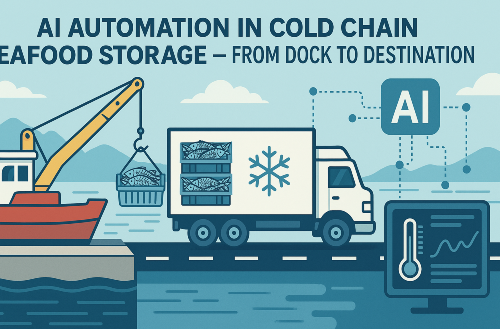
Intro: Why Cold Chain Seafood Needs AI Now
Cold chain failures silently drain profits and trust. This series explores how AI can transform seafood storage into a resilient, audit-ready operation.

The Hidden Crisis in Seafood Cold Storage
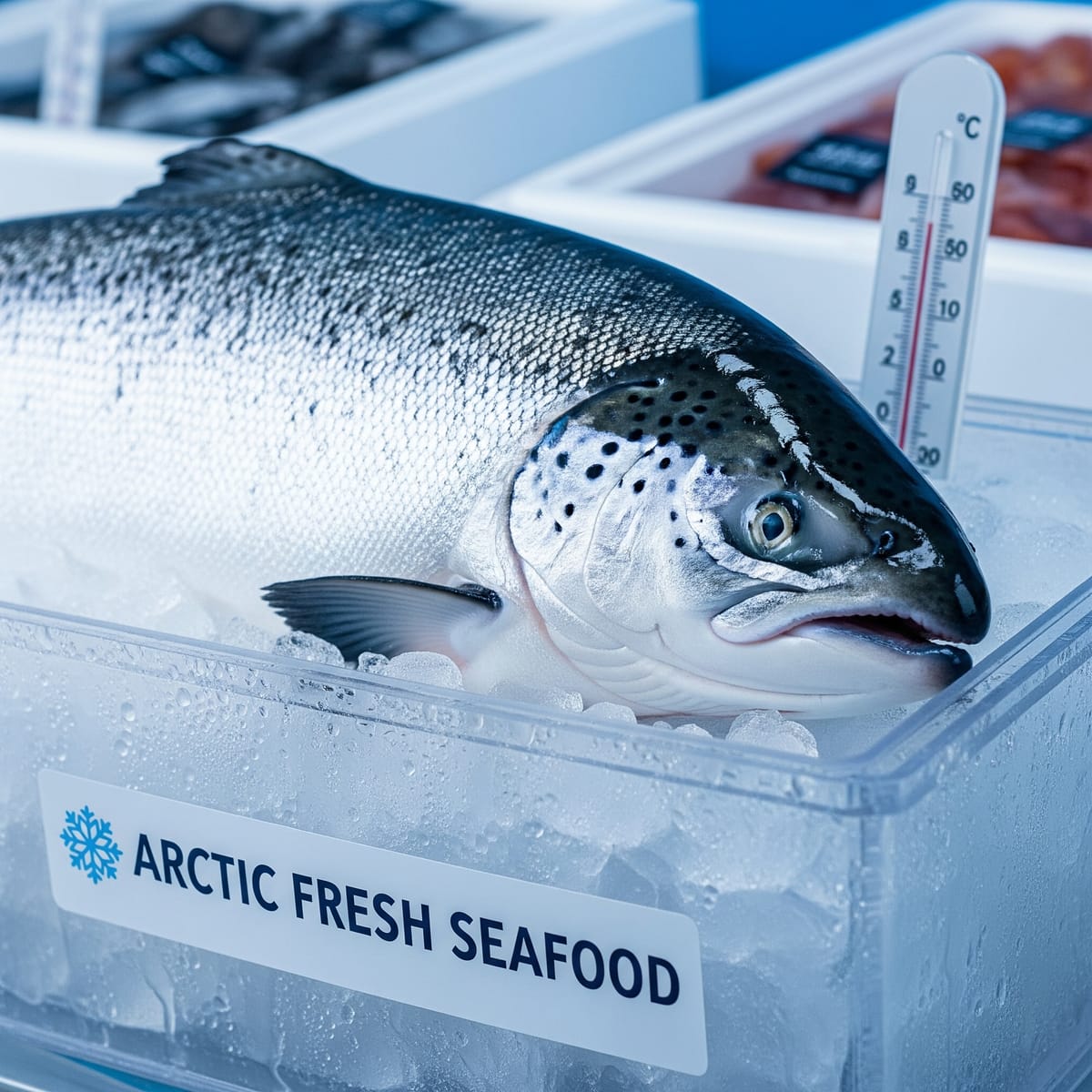
Every 1°C deviation in cold storage temperature can cut seafood shelf life by days. Yet across export hubs, facility managers often learn about these deviations after spoilage has already occurred. The result? Shipments worth lakhs are rejected, compliance audits fail, and customer trust erodes overnight.
Seafood is uniquely vulnerable:
- Perishability: Shrimp, tuna, and salmon degrade rapidly if storage slips even slightly.
- Global journey: From dock to container to overseas distributor, seafood may pass through 4–6 handoffs, each a potential weak link.
- Compliance complexity: Export certificates demand continuous logs that many facilities still compile manually.
The cold chain is supposed to be airtight, but in practice it is fragile—dependent on manual logs, periodic checks, and equipment that often lacks proactive monitoring.

Real Incidents from the Field
Incident 1: The Silent Drift
A facility in Kochi lost nearly ₹12 lakh worth of prawns when the blast freezer’s temperature drifted from -20°C to -14°C overnight. The staff discovered it only the next morning, long after spoilage began.
Incident 2: The Missed Door Event
In Visakhapatnam, a cold room door was left ajar during a midnight loading. The compressor kept running at 100% duty, but by morning, temperature logs showed a 6-hour breach. The shipment failed EU compliance tests, and the exporter was fined heavily.
Incident 3: Sensor Failure During Audit
A Chennai exporter faced an embarrassing audit when their primary probe stopped recording mid-shipment. Without backup data, the container was held at port for weeks, resulting in penalties and buyer contract termination.
Incident 4: Energy Drain Without Warning
A Mangalore storage unit unknowingly operated with an iced-up coil for 10 days. Energy bills spiked by 18%, and cooling performance degraded, putting 60 tonnes of tuna at risk.
These aren’t isolated stories—they’re recurring patterns across facilities. Each represents lakhs lost and reputations damaged.
The Real Costs of Cold Chain Failures
- Financial Loss: A single rejected 200-tonne shipment can erase annual profits for a mid-sized exporter.
- Regulatory Risk: Certification bodies are increasingly unforgiving. Even a minor temperature anomaly can void export permits.
- Reputation Damage: Global buyers demand reliability. Once a supplier is flagged for quality failures, regaining trust is an uphill battle.
- Operational Inefficiency: Managers spend hours reconciling paper-based logs instead of focusing on preventive action.
Where AI Fits In
AI doesn’t replace equipment—it augments it. By continuously monitoring sensors, detecting anomalies in real time, and predicting shelf life, AI can turn fragile operations into resilient ones.
Think of it as having a digital manager on duty 24/7—one that never sleeps, never misses a log, and flags issues before losses spiral out of control.
High-Level AI Workflow for Cold Chain Seafood
To understand where AI fits in, here’s a simplified end-to-end workflow for seafood cold storage:
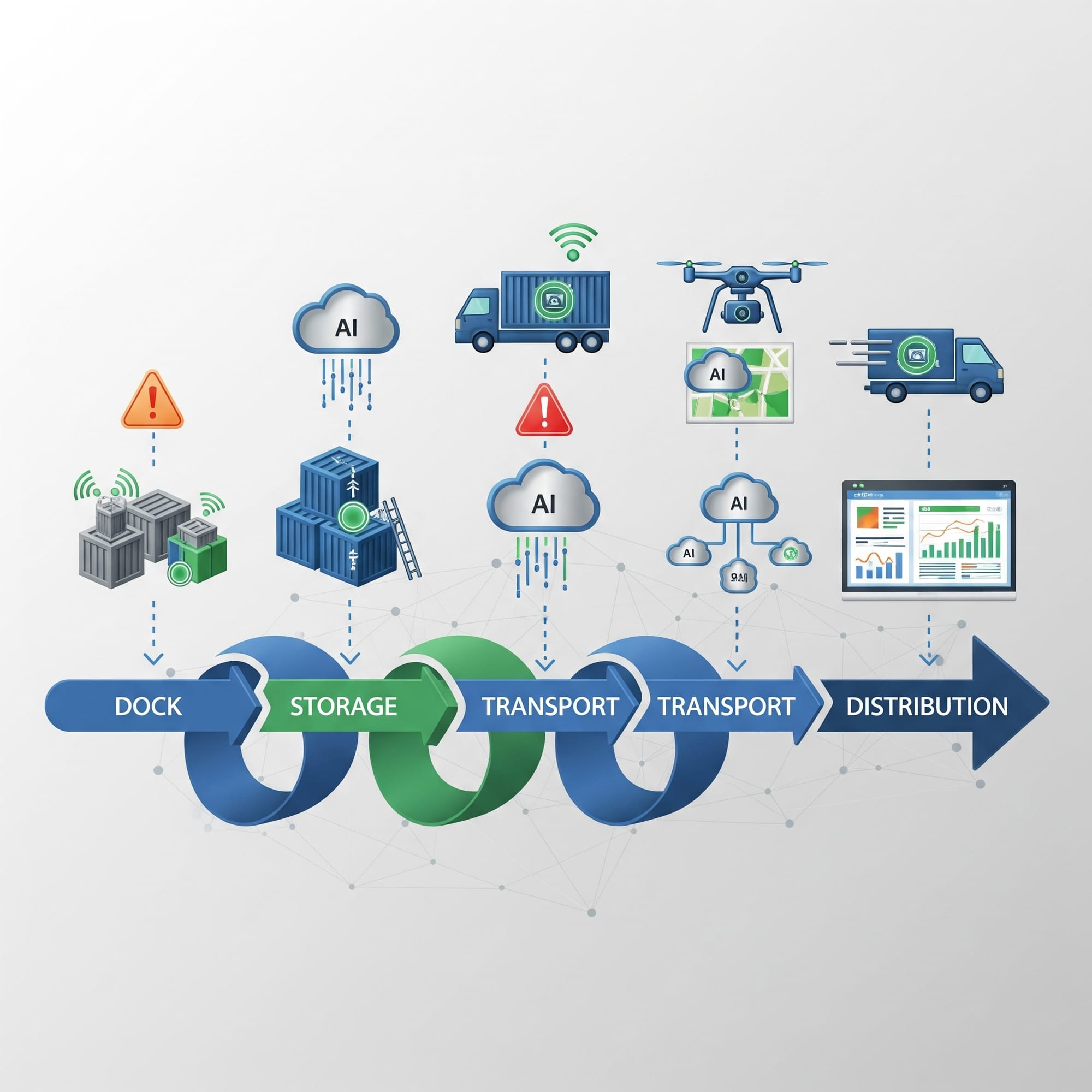
- Data Collection
- IoT temperature & humidity sensors in chambers and containers.
- Door open/close sensors and compressor health data.
- Optional: Camera feeds for visual monitoring.
- Data Transmission
- Edge gateways send data securely via MQTT/HTTP to a central platform.
- Offline buffering ensures no data loss during connectivity issues.
- AI Processing & Detection
- AI models monitor temperature patterns, door events, and compressor cycles.
- Anomaly detection identifies deviations before spoilage occurs.
- Shelf-life prediction models estimate freshness in real time.
- Alerts & Notifications
- Automated alerts sent via WhatsApp, SMS, or email to facility managers.
- Critical thresholds trigger escalation protocols for rapid response.
- Compliance & Reporting
- AI auto-generates audit-ready logs and compliance certificates.
- Reports summarize daily performance, anomalies, and shelf-life projections.
- Business Insights
- Inventory spoilage trends, energy usage optimization, and predictive maintenance.
Data-driven decision-making for exports and buyer negotiations.
What This Blog Series Will Cover
This is the first post in our series: AI Automation in Cold Chain Seafood Storage — From Dock to Destination. Each episode focuses on a specific pain point, with a practical AI-powered solution:
- Real-Time Temperature Anomaly Detection
How to stop losing lakhs of prawns overnight by letting AI watch storage 24/7. - Predicting Shelf Life with AI Models
From raw sensor data to accurate predictions of freshness and expiry. - Automating Compliance Certificates
AI that generates export-ready documents automatically, reducing errors and delays. - AI Alerts for Door Open/Close Monitoring
Use cameras and AI to ensure door management doesn’t compromise storage integrity. - Weekly Inventory & Spoilage Reports
AI-generated analytics that show waste, trends, and cost savings.
Each tutorial will be practical, intuitive, and connected to real business impact. Along the way, we’ll highlight how these solutions can be productized—whether as SaaS tools, consulting packages, or training for facility managers.
Why Start Now
Global seafood demand is rising, and with it, buyer scrutiny. Facilities that adopt AI-based monitoring early will:
- Protect profits by avoiding spoilage.
- Pass compliance audits with confidence.
- Strengthen buyer relationships with data-backed reliability.
This series is designed to help you take those steps—starting with understanding the scale of the problem and then moving into the solutions, one episode at a time.
Coming Next: Real-Time AI Temperature Anomaly Detection
Before you lose $6,000 worth of shrimp overnight, discover how to deploy anomaly detection that alerts you instantly. Stay tuned for Episode 2.